
Automating Software Testing with Generative AI
Software releases move faster than ever, while user expectations around reliability, speed, and security keep rising. Yet quality assurance (QA) often becomes a bottleneck when teams ship frequent updates and test suites lag behind new features.
Modern software teams ship features faster than ever, often pushing updates multiple times a week across web apps, APIs, and cloud platforms. Yet quality assurance (QA) frequently struggles to keep pace when test creation, maintenance, and edge-case coverage depend entirely on manual effort.
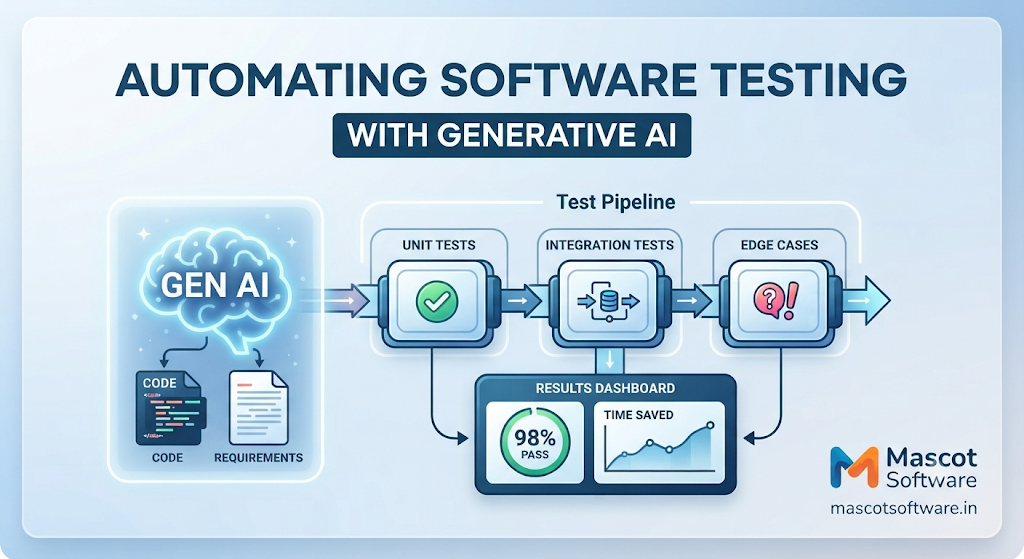
Generative AI offers a practical way to ease that bottleneck. Rather than replacing human QA engineers or deterministic test runners, generative AI helps teams draft test scenarios faster, create realistic synthetic test data, spot overlooked edge cases, and keep test suites moving alongside changing codebases.
For software companies, product teams, and development agencies, adopting generative AI in testing works best when it supports disciplined engineering workflows rather than bypassing code and test review.
High-Impact Areas Where Generative AI Helps in Testing
1. Turning Requirements and User Stories into Test Cases
Product specifications, acceptance criteria, and API contracts can be dense, making it easy to overlook subtle failure conditions during test planning. Generative AI can convert feature requirements into structured positive, negative, and boundary test cases—giving QA teams a solid baseline checklist in a fraction of the time.
2. Drafting Unit and Integration Test Scaffolding
Writing boilerplate unit tests, mock objects, and setup code often slows down feature delivery. AI coding assistants can generate initial unit or integration test drafts tailored to your testing framework (such as Jest, Vitest, Pytest, JUnit, or Playwright), allowing engineers to focus on verifying business logic and assertions.
3. Generating Realistic Synthetic Test Data
Thorough testing requires varied inputs—such as multi-role user accounts, edge-case strings, invalid payloads, and boundary dates—without exposing sensitive production records. Generative AI can produce realistic mock datasets and test fixtures that protect customer privacy while improving scenario coverage.
4. Uncovering Edge Cases and Regression Scenarios
When a new module or bug fix lands, developers naturally test the main path they just built. Generative AI can help brainstorm adjacent failure modes—such as empty states, timeout retries, permission mismatches, or partial form submissions—that often cause production regressions.
A Practical Workflow for Safe Adoption
Generative AI can sometimes produce plausible-looking test code or assertions that miss subtle domain rules or introduce flakiness. To keep your test suite dependable, follow four core practices:
-
Separate Test Generation from Test Execution: Use generative AI to draft tests, edge cases, or sample payloads, while deterministic test runners and CI/CD pipelines execute the checks consistently.
-
Review Every Generated Test Like Production Code: Have a developer or QA engineer inspect assertions, mocks, and cleanup logic so brittle or false-positive tests do not slip into your suite.
-
Keep Sensitive Data Out of External Prompts: Never paste production credentials, API keys, customer personal data, or confidential client code into unapproved tools.
-
Track Real Quality Outcomes: Measure success through meaningful signals—such as coverage of critical user journeys, fewer production regressions, and faster QA turnaround—rather than raw test volume.
Where Human QA and Traditional Testing Still Lead
Generative AI accelerates test authoring and test design, but it cannot replace end-to-end engineering judgment:
-
Real-Environment Verification: Cross-browser behavior, mobile responsiveness, network latency, and real integration environments require actual execution.
-
User Experience and Business Context: Only humans can judge whether a workflow feels intuitive, clear, and aligned with real business goals.
-
Security, Performance, and Compliance Audits: Load testing, penetration testing, and regulatory checks require dedicated tools and specialized engineering review.