

What Is Agentic AI? How Autonomous Workflows Differ from Basic Automation
For years, business automation meant setting up rigid rules: if a customer fills out a form, send an email; if an invoice arrives, route it to a folder. While basic automation handles predictable, repetitive steps well, it breaks the moment something unexpected happens.
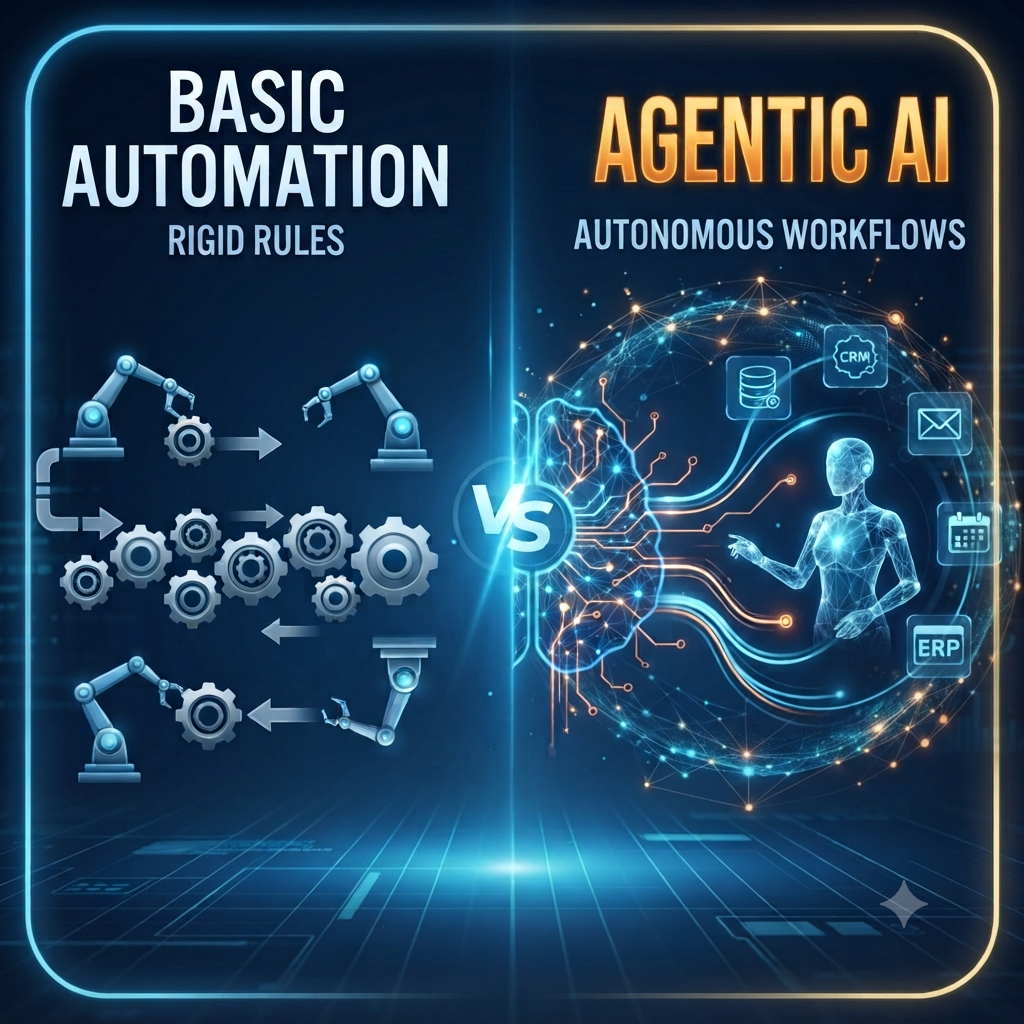
For years, business automation meant setting up rigid rules: if a customer fills out a form, send an email; if an invoice arrives, route it to a folder. While basic automation handles predictable, repetitive steps well, it breaks the moment something unexpected happens.
Enter Agentic AI, the next evolution in enterprise automation. Instead of simply following fixed scripts, Agentic AI uses reasoning, memory, and connected software tools to plan and execute multi-step workflows autonomously.
For growing businesses looking to streamline operations, understanding the shift from basic automation to Agentic AI is essential.
What Is Agentic AI?
Agentic AI refers to artificial intelligence systems designed to act as autonomous digital workers, or AI agents, that can pursue a goal with minimal human intervention.
Unlike standard generative AI chatbots that only answer prompts when asked, an AI agent can:
-
Understand an objective, such as qualifying an inbound lead, checking inventory, and scheduling a demo.
-
Break the goal into logical steps.
-
Interact with external tools such as CRMs, ERPs, databases, email platforms, and APIs.
-
Evaluate outcomes and adapt if an error or edge case occurs.
In short, traditional AI generates text; Agentic AI takes action.
Basic Automation vs. Agentic AI: Key Differences
Most businesses already use traditional rule-based automation, such as simple webhooks, macros, or fixed if-this-then-that triggers. Here is how autonomous agentic workflows compare across core areas:
1. How It Works
Basic Automation follows strict, pre-programmed If-Then rules. Agentic AI plans dynamically based on goals and context.
2. Handling Exceptions
Basic Automation fails or stops when encountering unexpected inputs. Agentic AI adapts, retries, or escalates smartly to a human.
3. Data Processing
Basic Automation requires structured, standardized inputs. Agentic AI handles unstructured data such as emails, PDFs, voice calls, and chat messages.
4. Decision-Making
Basic Automation has zero reasoning and executes exact instructions. Agentic AI evaluates options and chooses the next best action.
5. System Integration
Basic Automation simply moves data from Point A to Point B. Agentic AI reads, updates, and coordinates actions across multiple applications.
Real-World Business Use Cases for Agentic Workflows
At Mascot Software, we see businesses moving beyond simple bots toward integrated AI workflows that solve real operational bottlenecks:
1. Autonomous Lead Qualification and Sales Operations
With basic automation, a system sends a generic auto-reply when a prospect submits a contact form. With an agentic workflow, the AI reads the inquiry, enriches company details, checks CRM history, answers specific product questions over WhatsApp or email, and books a meeting directly on the sales representative's calendar.
2. Intelligent Document and Invoice Processing
With basic automation, software extracts fixed fields from a single standardized PDF template. With an agentic workflow, the system uses Document AI and OCR to read varied vendor invoices, cross-checks line items against purchase orders in your ERP, flags discrepancies, and drafts an approval request for your finance team.
3. End-to-End Customer Support Resolution
With basic automation, a bot replies with FAQ links and creates a support ticket for human agents. With an agentic workflow, the AI verifies customer identity, checks live order or account status in your database, processes eligible refunds or updates, and only escalates complex edge cases with a full summary attached.
Keeping Control: Human-in-the-Loop Governance
Autonomous does not mean unsupervised. Well-engineered Agentic AI includes strict guardrails:
-
Role-Based Permissions: Agents only access the specific APIs and records required for their task.
-
Approval Checkpoints: High-stakes actions, such as issuing refunds above a certain limit or sending external contracts, pause automatically for human approval.
-
Audit Logs: Every decision and tool call is logged so teams maintain full visibility and compliance.
How to Start Adopting Agentic AI in Your Business
You do not need to overhaul your entire tech stack overnight. The smartest approach is to start with one high-friction workflow:
-
Identify a bottleneck involving unstructured inputs and multiple software tools, such as lead intake, invoice reconciliation, or support triage.
-
Start with a focused pilot with clear KPIs, such as turnaround time saved or manual errors reduced.
-
Integrate with your core systems like your CRM, ERP, or custom databases so the agent has accurate, real-time context.
Build Custom AI Automation with Mascot Software
Off-the-shelf tools often fall short when your workflows span custom software, regional compliance needs, or proprietary databases. At Mascot Software, we design and build tailored AI Chatbots, Voice Agents, Document AI pipelines, and Custom CRM and ERP integrations built around how your business actually operates.
Ready to automate your complex workflows? Visit https://mascotsoftware.in/ to schedule a consultation and discover where Agentic AI can save time and drive growth for your team.
.jpeg)
.jpeg)